
A clock, not a page turn
The round runs on its own time and the whole table rides it together — the decision is when to bank, with the number still moving.

Ride the wave. Beat the best.
In development — the demo simulates its own rounds
Yachter is a crash game on a clock. A betting window opens, the yacht launches, and the multiplier climbs with the wave until the player banks it or the boat wipes out. Two bet slots run side by side, each with its own auto bet and auto cash-out, and everyone in the round is riding the same wave.

Crash splits into two kinds of game, and Yachter is the other one. Crashbook waits for the player: nothing moves until a page is turned. Yachter does not — bets close, the yacht launches, and the multiplier climbs on a clock whether or not anyone is watching. The pressure comes from the same question asked a different way, and the two titles between them cover both halves of the crash audience.
The climb is continuous: the multiplier is e raised to 0.14 times the seconds elapsed, which reaches 2× in about five seconds, 5× in eleven and a half and 10× in sixteen and a half. Where a round ends is drawn before it starts, from a distribution in which the chance of reaching any multiplier is the house edge subtracted from one and divided by that multiplier — so a draw that lands below 1.00× wipes out on launch, and that is where the edge sits.
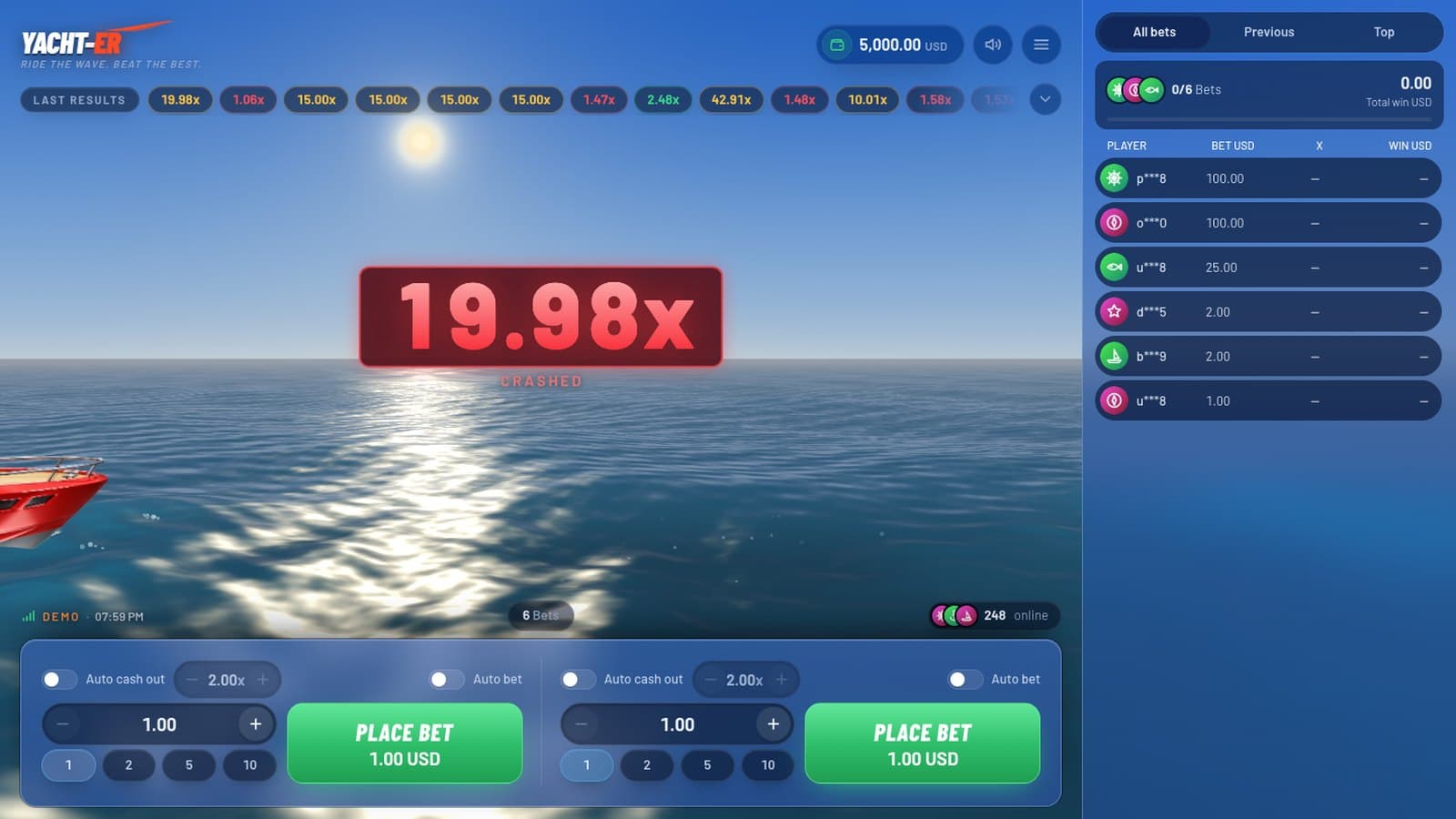
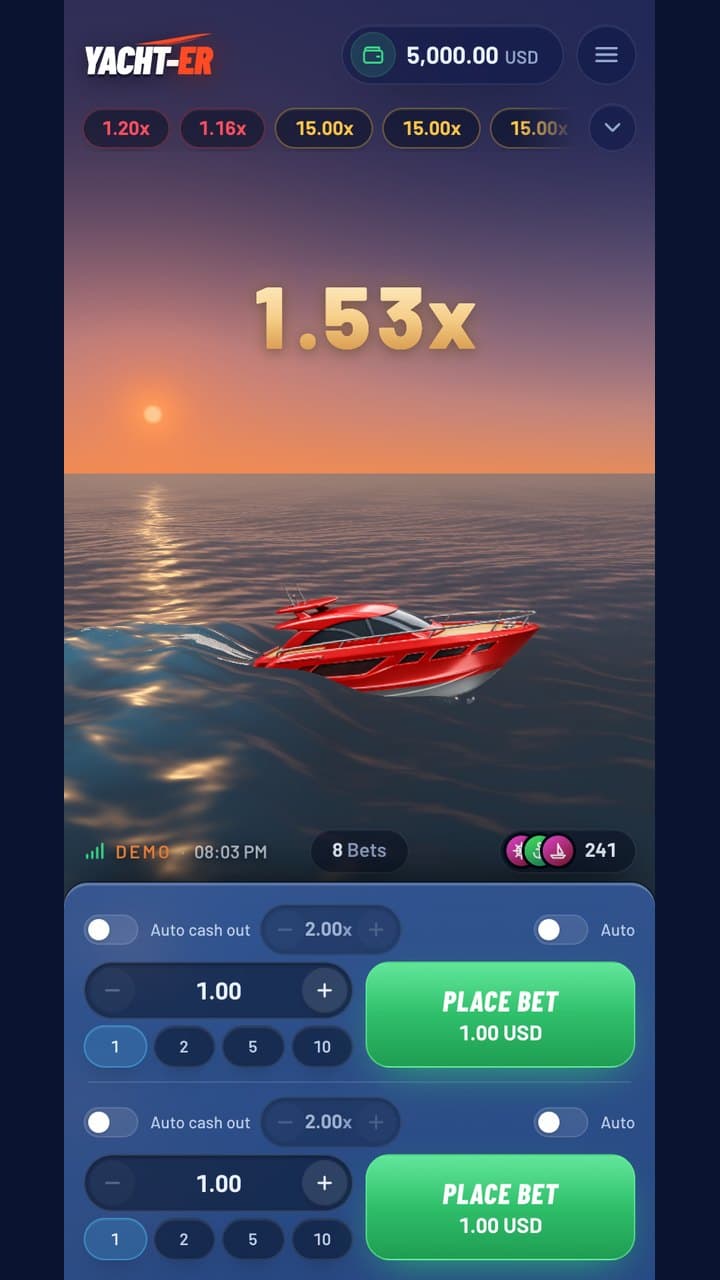
The stage is a PixiJS sea with a day running through it: the sky turns from dawn towards night as the multiplier climbs, so a round that reaches 10× does not look like one that ended at 1.5×. The engine publishes an authoritative frame twenty times a second and the stage interpolates between those frames, so the number on screen moves at the display's rate rather than the network's. Where WebGL cannot start, a Canvas 2D scene takes over rather than the game refusing to load.
It is a prototype, and the site says so wherever it appears. The build simulates its own rounds, balance and table of players in the browser — there is no wallet behind it and no real money in it — and the mathematics above is the configuration it currently runs on, not an audited result. The engine sits behind one interface, so the work to put it on the platform is an adapter rather than a rewrite; the audit comes before it reaches an operator.
The settings this build currently runs on, read from its own configuration. None of it has been audited — that happens before a title reaches an operator, and the figures can still move until it has.
Format
Timed crash
Betting window · launch · climb · wipe-out
Multiplier curve
e^(0.14·t)
2× at ~5s · 5× at ~11.5s · 10× at ~16.5s
House edge
3.0%
Configured — not yet audited
Ceiling
1,000×
Current prototype setting
Bet slots
Two, side by side
Auto bet and auto cash-out on each
Frame rate
20 Hz authoritative
The stage interpolates between ticks
The build has no wallet behind it: rounds, balance and the table of players are simulated in the browser. The figures above are the configuration it runs on today, not a measured return.
What the title gives a lobby, and what it asks of the platform behind it.
The round runs on its own time and the whole table rides it together — the decision is when to bank, with the number still moving.
Two bet panels side by side, each with auto bet and auto cash-out, so a player can bank one position early and let the other run.
The sky moves from dawn towards night as the multiplier climbs, so how far a round went is legible before the number is read.
The stage, the panels and the players table are laid out for a phone held upright first, and open out from there.
Where the GPU scene cannot start, a Canvas 2D sea takes over instead of the game refusing to load.
The client talks to a single engine interface. Putting it on the platform means writing an adapter to it, not touching the stage or a component.
Captured from the live build — the same one the demo above opens.
Play the prototype, then talk to our team about where it fits your lobby and what you would want from it before launch.
Age verification
This site showcases real-money casino games built for licensed operators. Sakaura Studios is a game studio — it does not accept wagers and is not a place to play. Please confirm your age to continue.
18+ only. Please gamble responsibly — GambleAware.